Why Does an Excavator Overheat Under Heavy Load but Run Normally at Idle?
An excavator that runs at a normal temperature while idling but begins to overheat during heavy digging, lifting, traveling, or continuous operation usually has a cooling system that can handle light heat loads but struggles when demand increases.
This does not always mean that the radiator or another cooling component has completely failed. In many cases, the system is still working, but its available cooling capacity has been reduced by restricted airflow, lower fan performance, limited coolant circulation, increased hydraulic heat, or other operating conditions.
The key is to understand the operating pattern. If the temperature rises mainly during heavy work and then drops again after the machine returns to idle or light load, the problem is often related to insufficient cooling margin rather than a total cooling system failure.
Heavy-load overheating often means the cooling system still works, but it can no longer reject heat fast enough under actual working conditions.
Why Heavy Load Changes the Cooling Requirement
Excavators generate significantly more heat during heavy operation than they do at idle. When the engine works harder, fuel consumption increases and more heat must be removed through the cooling system.
At the same time, the hydraulic system is also under greater load. Continuous digging, boom movement, lifting, traveling, and other high-pressure hydraulic operations convert more energy into heat, which raises hydraulic oil temperature and increases the total heat load around the cooling package.
Under light conditions, a radiator with partially restricted airflow or slightly reduced cooling performance may still keep the machine within a normal temperature range. Once the excavator enters continuous heavy operation, however, the available cooling capacity may no longer be enough.
This is why some cooling problems remain hidden during idle testing and only appear after the machine has been working for a period of time.
Heavy Load → More Engine and Hydraulic Heat → Higher Cooling Demand → Existing Cooling Weakness Becomes Visible
The Cooling System Has Lost Its Safety Margin
A cooling system does not need to fail completely before overheating begins. In many excavators, the radiator, fan, coolant circuit, and hydraulic cooling components may still function normally enough during idle or light-duty operation.

The problem appears when the system has lost part of its original cooling margin. Small reductions in airflow, heat transfer, coolant circulation, or fan performance may have little effect at low load, but they become much more important once the excavator begins continuous heavy work.
For example, a radiator with partially blocked fins may still remove enough heat while the engine is idling. During heavy digging, however, engine heat and hydraulic heat increase at the same time. If the radiator can no longer transfer heat quickly enough, coolant temperature will continue to rise.
An excavator can run normally at idle even when the cooling system is already operating close to its limit.
This is why heavy-load overheating should not be judged only by whether the radiator, fan, or water pump is still working. The more useful question is whether the complete cooling system still has enough capacity for the machine’s actual operating conditions.
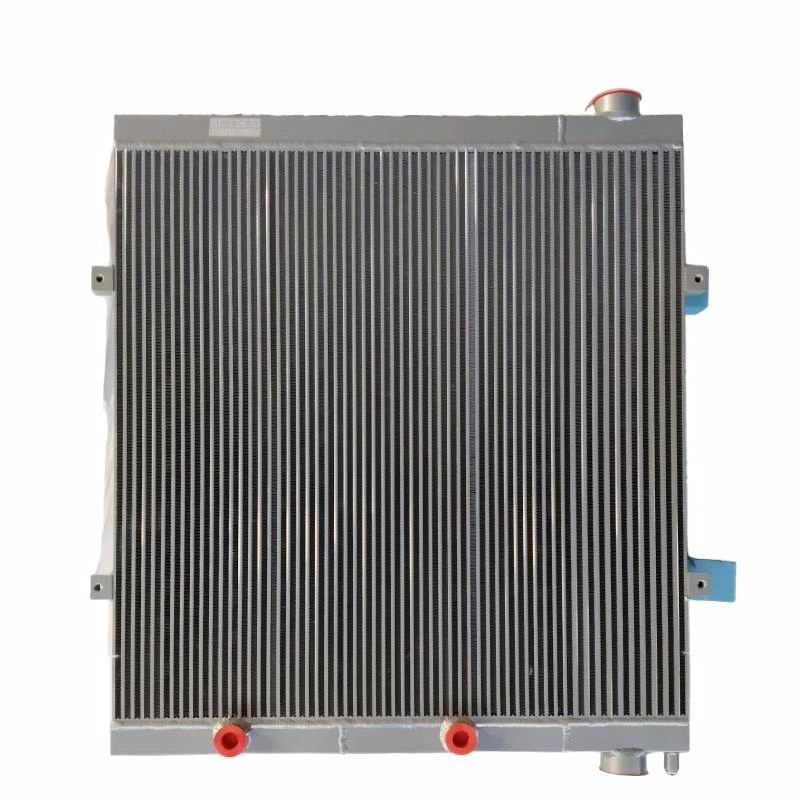
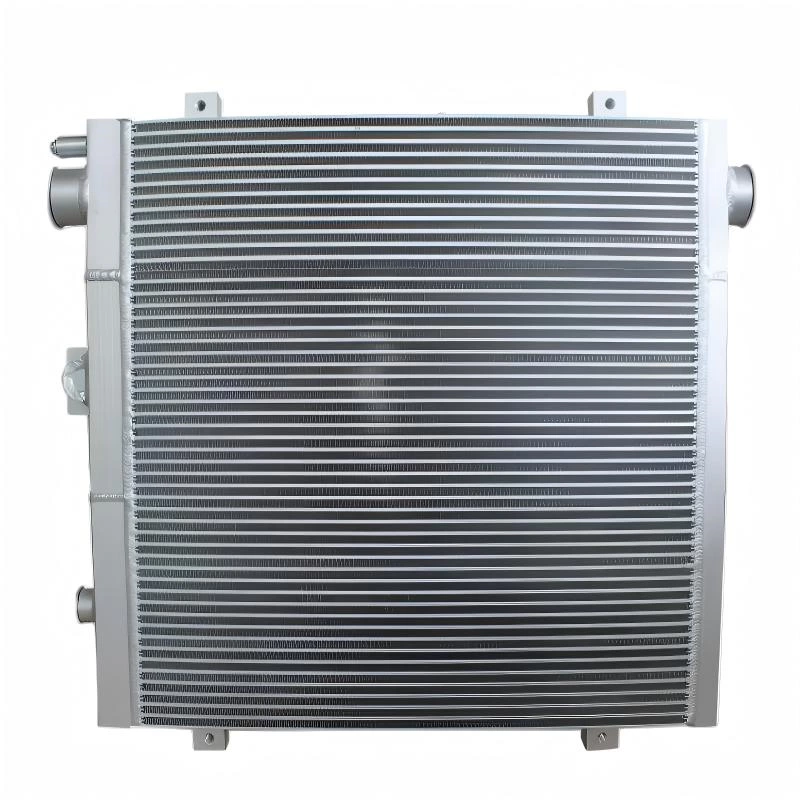
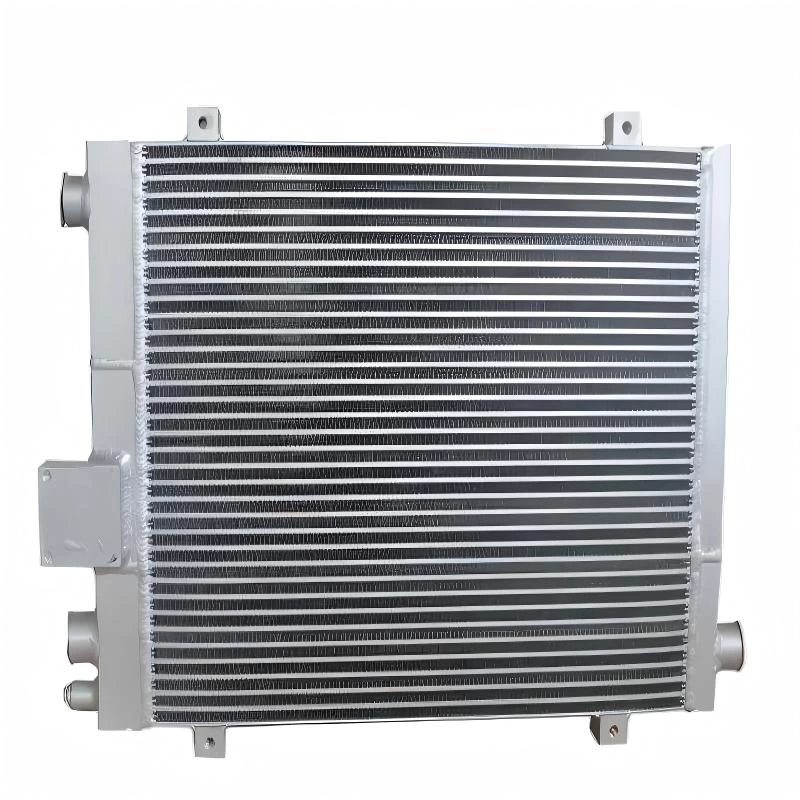
Partial Radiator Blockage Can Restrict Airflow Under Load
Airflow restriction is one of the most common reasons an excavator cools normally at light load but overheats during continuous operation. Construction equipment often works around dust, soil, fibers, mud, and other airborne debris that can gradually accumulate on the radiator surface.
The radiator does not need to be completely blocked to create a problem. Even partial buildup between the fins can increase airflow resistance and reduce the volume of cooling air passing through the core.
At light load, the remaining airflow may still be enough to maintain a normal operating temperature. Under heavy load, the radiator must reject much more heat, so the same airflow restriction becomes more significant.
Bent or damaged fins can create a similar effect. When fin passages become restricted, the fan must work against greater airflow resistance, while less air reaches the effective heat-transfer surface.
Machines operating in dusty environments may require a different balance between heat-transfer surface area and resistance to contamination. You can learn more about this in our guide to radiator fin spacing in dusty environments.
If an excavator overheats mainly after extended digging or other high-load work, inspecting the complete airflow path through the radiator and surrounding cooling package should be one of the first checks.

Fan Performance May Be Insufficient at High Cooling Demand
A radiator can only reject heat effectively when enough air passes through the cooling core. This means that fan performance becomes especially important when the excavator is working under sustained load.
A fan may appear to be operating normally but still fail to provide enough airflow. Reduced fan speed, belt wear, hydraulic fan problems, damaged blades, or an incorrectly positioned shroud can all lower the amount of air moving through the radiator.
Air recirculation can also reduce cooling efficiency. If hot air leaving the radiator is drawn back toward the inlet side, the radiator receives warmer air instead of cooler ambient air, reducing the temperature difference available for heat transfer.
A fan that is turning is not necessarily providing enough airflow for heavy-load cooling.
This is why fan inspection should focus on actual airflow performance rather than simply checking whether the fan rotates.
Hydraulic Heat Increases During Heavy Digging
Excavators rely heavily on hydraulic power, so the hydraulic system can add a significant amount of heat during continuous operation. Digging, lifting, boom movement, bucket operation, traveling, and other high-pressure functions all increase hydraulic workload.

As hydraulic pressure and flow increase, part of the input energy is converted into heat. Hydraulic oil temperature therefore rises more quickly during demanding work than during idle or light-duty operation.
This additional heat matters because the hydraulic oil cooler is often installed within the same cooling package as the engine radiator and other heat exchangers. When several components must reject heat through the same airflow path, the total cooling demand can increase substantially.
If both engine coolant temperature and hydraulic oil temperature rise during heavy digging, the problem should not automatically be blamed on the engine radiator alone. The cooling package, fan performance, airflow restriction, hydraulic heat generation, and oil cooler condition should be evaluated together.
This is particularly important on machines that operate continuously at high hydraulic load, such as excavators used for heavy digging, lifting, quarry work, demolition, or long travel cycles.
Coolant Flow May Be Marginal Rather Than Completely Failed
Not every coolant circulation problem causes immediate overheating. In some cases, the cooling circuit still operates, but coolant flow is lower than it should be.
A thermostat that does not open fully, a worn water pump, internal deposits, trapped air, or poor coolant condition can reduce circulation through the radiator. At idle or light load, the remaining flow may still be enough to control temperature.
Under heavy load, however, the engine produces more heat and requires faster heat transfer through the cooling circuit. If coolant circulation is already restricted, the system may no longer move heat away from the engine quickly enough.
This type of problem can be difficult to identify because the radiator may appear clean and the fan may be working normally. The overheating only becomes obvious after the excavator has been operating under sustained load for a period of time.
For this reason, coolant flow should be evaluated together with airflow and radiator condition rather than treated as a separate issue.
High Ambient Temperature Removes the Remaining Cooling Margin
An excavator that performs normally in cool weather may begin to overheat when ambient temperature rises. This does not always mean a new fault has suddenly developed. Higher outside temperature can simply expose a cooling system that is already operating close to its limit.
Radiator performance depends partly on the temperature difference between the hot coolant and the incoming cooling air. When ambient air becomes hotter, that temperature difference becomes smaller, so the radiator has less ability to reject heat under the same operating conditions.
This effect is more noticeable during continuous heavy work, especially in mining, construction, quarry, desert, or enclosed jobsite environments where both heat load and ambient temperature are high.
A machine that overheats only in hot weather may have insufficient cooling reserve rather than a completely failed radiator.
If overheating becomes worse as ambient temperature increases, the cooling system should be checked for airflow restriction, reduced fan performance, coolant flow limitations, and whether the radiator has enough capacity for the actual operating environment.
Frequently Asked Questions
Why does my excavator overheat only when digging?
Heavy digging increases both engine load and hydraulic system load, so the machine produces more heat than it does at idle. If radiator airflow, fan performance, coolant circulation, or overall cooling capacity has already been reduced, the problem may only become visible during sustained digging.
Why does the temperature drop when the excavator returns to idle?
When the machine returns to idle, engine and hydraulic heat generation decrease. If the cooling system is still functioning but has limited reserve capacity, it may once again be able to remove heat faster than the machine produces it, causing the temperature to fall.
Can a dirty radiator cause overheating only under heavy load?
Yes. A partially blocked radiator may still provide enough cooling during light operation. Under heavy load, however, reduced airflow through the core can prevent the cooling system from rejecting heat quickly enough.
Can hydraulic oil temperature affect engine cooling?
Yes. On many excavators, the hydraulic oil cooler and engine radiator share the same airflow path or cooling package. High hydraulic heat can therefore increase the total heat load that the fan and cooling package must handle.
When should an excavator radiator be replaced?
Replacement should be considered when the radiator has serious internal restriction, leakage, corrosion, damaged fins or brazed joints, physical deformation, or insufficient cooling performance after airflow, fan operation, coolant circulation, and other system conditions have been checked.
Conclusion
When an excavator overheats under heavy load but runs normally at idle, the problem often means the cooling system still functions but no longer has enough reserve capacity for demanding operating conditions.
Restricted radiator airflow, reduced fan performance, hydraulic heat, limited coolant circulation, high ambient temperature, and changes in duty cycle can all reduce the available cooling margin. In many cases, several small factors combine rather than one component failing completely.
The most effective diagnosis is therefore to evaluate the complete cooling system under actual working conditions. If the radiator is damaged, restricted, or no longer suitable for the application, replacement or custom matching should be based on the excavator model, OE number, dimensions, mounting points, connection layout, and operating requirements.
For excavator radiator replacement or custom matching, contact our engineering team with your machine information, drawings, photos, OE number, or existing radiator specifications.